Showing posts with label lifestyle change. Show all posts

Thursday, October 23, 2014

One Diet that Really Works

"What is the fastest way to lose weight?" 


It has to be the most often asked question I get as a Trainer and Coach.  The answer is simple:

Stop eating and drinking.  Everything.
And, if you have any energy left, you should exercise at a high intensity all day long.

But we all know that that's bad advice.  (Seriously, people - don't do it.)  But, if you ask the question, I'm going to give you the correct answer.  The problem isn't the answer, it's the question.

You want to lose weight fast.

I get it.  The scale isn't moving.  You're stuck.  You're trying (operative word) to eat better.  You're trying (operative word, again) to exercise regularly.  But, you're just not losing weight fast enough.  Fast enough for what?  For someone to notice?  To fit into your pants again?  To look good in a swim suit?

Who set the goal for rate of weight loss?  Was it you?  Are you trying to meet a deadline, like a trip to a beach in four weeks, or a reunion in three months?

What happens when you diet?


Typically, a diet is a temporary calorie or food restriction.  You eliminate calories or certain "bad" foods from your diet.  The result?  You lose weight.  Then, when you reach your desired goal weight, you celebrate, because "You Made It"!  The end of the diet, typically means that the calorie and food restrictions can be lifted.

Friend:  "Wow.  You look great!  How much weight did you lose?"
You:  "Twenty pounds!  I haven't been at this weight in ten years."
Friend:  "How'd you do it?"
You:   "I was on this really great diet.  I could eat as much vegetables as I wanted.  I was allowed (ooh - I hate those words) to eat lean meats like chicken and fish and I could eat a couple servings of fruit a day."
Friend:  "So - you must be pretty excited.  Wanna go out for pizza and beer tonight to celebrate?"
You:  "Well, I really like how I feel, so I want to keep eating like this as much as possible.  But, I guess as long as I have a huge salad with pizza, I'll be just fine.  And, a couple of beers won't hurt."

Friend:  "Atta boy!"

After the diet.


Any calorie or food restriction will help you lose weight.  Often, the more restricted, the more weight you will lose, faster.  With any restriction, however, there are side effects, the most noticeable being irritability and lack of energy.  But, if you get to your goal weight, you definitely don't want to gain it back, right?  (Please see previous blog on the dangers of Yo-Yo Dieting.)  So, the secret (hush - don't tell anyone, right?) has to be in what you do after you've reached your weight loss goal.

Certainly, a diet that is restrictive will help you lose weight, until you reach a plateau.  When you reach a plateau, you'll have to further restrict calories or food to continue to lose weight.  If you're happy at your set point, you simply need to continue to do what has been working for you up to this point.  Stay on your current diet and not waiver from it at all.

Example of a plateau:  Joe weighs 200 pounds.  It takes 2,000 calories to keep (burn) his 200 pound body alive and functioning (also called basal metabolic rate).  Joe is on a 1,500 calorie/day diet and loses one pound a week.  At the end of six months, Joe loses approximately 24 pounds.  At 176 pounds, Joe's body now burns about 12% less (See laws of Thermodynamics.)  Therefore, if he stays on a 2,000 calorie/day diet, his rate of weight loss will slow to about .5 pounds/week.  The less Joe weighs, the less calories Joe needs to sustain his weight.  When Joe decides that he's reached his goal weight, his calorie and/or food restriction may be so much that it is not sustainable.  Therefore, as Joe  starts adding back foods and calories, he will eventually gain weight back.

Avoiding the Yo-Yo.

What's going to be most important after successful weight loss, is keeping it off, which is often harder than taking it off in the first place.  In order to keep the weight off once and for all, you'll have to change the way you eat permanently.  If a low carbohydrate diet helped you lose weight, and you had energy and weren't irritable, and didn't experience any other side effects, then stick with it.  If  a low fat diet helped you lose weight (and maybe because heart disease runs in your family), stick to it.

The Best Diet


Ultimately, the best diet is one that is a lifestyle solution and is sustainable for the long haul.  In my opinion, the best "diet" closely resembles the Paleo diet, which is basically eating sensible, with an emphasis on vegetables over meat, and choosing high quality, lean meats.  It's as close to eating fresh and natural as possible.  It specifically excludes processed and fast foods and refined flours, sugars and starches.  (Note:  this diet may not be for everyone.  See your doctor.)

The old saying, "You can't have your cake and eat it too" may just be right when it comes to losing and maintaining your weight and improving your overall health.  Moderation may or may not work for you.  More times than not, though, one person's idea of moderation, is all that is keeping them from losing weight.

The Living 365fitt, 12-Week Program to Lifestyle Wellness can help you figure out what's right for you and your health once and for all.  Chapter Eight, It's All About the Details, discusses directly what types of foods to choose to improve your health and potentially, lose weight.

If you need additional help, please contact Kathy at Kathy@365fitt.com for more information.

For related articles, see also:
Are Your Diets Failing You? Or, Are You Failing Your Diets (yo-yo dieting)
All You Wanted to Know About Fad Diets and More
Lose 24 Pounds in One Week
Raspberry Ketone Diet
What Isn't In a Diet Supplement?
The Anatomy of a Diet Scam


Tuesday, September 23, 2014

What Isn't in a Diet Supplement?

I was going to write about the top ingredients in weight loss and diet supplements, however, finding a reliable and impartial source is near to impossible.  Most of the top sources are also selling the products, so of course, they're going to say their products work!  Top ingredients in an almost exhaustive list include fruit fibers, proteins, green tea, caffeine, antioxidants and more.  These ingredients claim to suppress appetite and increase satiety, increase muscle mass and/or metabolism, and block fat and/or sugar absorption, to name just a few.  Some claims are real, while other claims are as thin as dental floss.  Even if the claims are real, the effect on your physical body, is typically negligible.  (See my previous blog post on 10% Pill, 90% Program:  it's really the associated program that causes the measurable results, and most programs include a change in diet (eat more good foods, and decrease or eliminate bad foods) and exercise.)

Why are diet supplements so popular then?

Diet supplements, in my opinion, are popular because of what's known as the "placebo effect".  Take a look at the picture.  All of these reasons, associated with a placebo (also called a sugar pill), can also be associated with diet pills.


TRUST

Diet pills are typically prescribed or offered by a trusted source.  If your doctor prescribes them (some doctors receive kickbacks, profits and fees for selling products) and you trust your doctor, you are more apt to take them regularly and believe that they will work.  If a television show that you trust (Dr. Oz, for example) demonstrates a new weight loss pill, plan or program, you are more apt to believe in the product.  If your best friend touts to you the benefits of the latest product that he/she has tried, you are more apt to believe it will work for you too.  In all cases, if the source can be trusted, you are more apt to believe in the results.

IMPROVED SENSE OF WELL-BEING 

Because you're doing something positive and good for yourself, you are more prone stick with it and, again, believe in the benefits.  Statements like, "I'm at least trying" are a positive self-affirmation, which can lead to success.

EXPECTATIONS

When a product claims to help you lose weight, and you expect it to help you lose weight, it just might work, because you tend to try hard to make it work.  When a product makes inflated claims (lose 20 pounds in one week!), you want it to work, almost desperately.  You expect it to be miraculous.  When you have a certain set of expectations, whether real or inflated (i.e. promotional), you think a product should behave a certain way.  If you expect a product to produce certain results, it stands a better chance of achieving success.

PHYSICAL EFFECT (BRAIN CHEMICALS)

Some research supports the fact that the brain behaves differently, even when taking a placebo.  There appears to be an increase in endorphins (and other hormones/chemicals), that actually physically change brain activity, when studied under a brain scan.  This increase in brain activity can create a causal effect between pill and weight loss.

CONDITIONAL RESPONSE


Similar to Pavlov's dog, some people are conditioned to the extent that just the thought of taking a pill for weight loss can induce a positive effect.  Certainly, this can be achieved through other stimuli as well.  For instance, you associate pain with fire, so you avoid touching fire.  You salivate when you smell french fries.  This may be especially true for people who have been successful in previous attempts to lose weight through weight loss supplements, thus creating a conditioned response.  When the thought of taking a diet pill to lose weight excites you to the point that you want it to work, possibly because it has in the past, it may have a positive effect.

 IT'S A CHOICE


Supplements have a purpose, but typically, the purpose is to lure you into thinking they work.  It's a billion dollar industry for a reason. 

Just remember to weigh the pros and cons of all supplements before trying them.  Ask yourself the following questions:

  1. How much does it cost?
  2. How long are you supposed to use them?
    • Multiply the cost by the length of time of use to get a true estimate of cost.
  3. Do the supplements come with a "program" that requires some form of exercise?
  4. Do the supplements come with a "diet" that reinforces any of the following:
    • Eating good foods
    • Avoiding bad foods (high carb/high fat/fried/fast food/processed food/sugary drinks)
    • Portion control
    • Fasting
  5. Do the supplements require any form of laxatives?
It's your body and it's your choice what you put into it, and how much you choose to spend, if anything on supplements.  Whatever you choose to do, just stay on the right track for the rest of your life; especially, the parts about incorporating daily exercise into your life, eating good foods, and avoiding bad foods.  Do it for life, even if you don't use the supplements anymore!

Living 365fitt,
Kathy

Contact Kathy at kathy@365fitt.com for individual coaching, or for one of the Living 365fitt Programs on lifestyle change.

Sunday, June 22, 2014

Podcast #2: Living 365fitt, Chapter Two, All About Habits with Anne Green

Changing your habits is hard.  


Kathy Kent, author of Living 365fitt, A 12-Week Program to Lifestyle Wellness, talks to Anne Green, psychologist and co-author of The Roadmap, about why it's so hard to change our habits.  Anne calls it "steadiness" when it comes to making decisions.  Listen to the podcast, learn about steadiness, and start making healthier choices.


About The Roadmap, by Anne Green and Jason Lassner (available at Amazon.com)

Crisis or Opportunity?  Many successful people are thwarted by habits they cannot change. These behavior problems run the gamut: weight loss, exercise, making a budget and sticking to it, stress and anger management, destructive relationship and communication patterns, and the list goes on.  In The Roadmap we meet one such woman named Jo, a 40-something wife, mother, and newly promoted sales manager as she confronts the harsh reality that she is a control freak (referred to in polite company as a “micromanager”). 

Willpower Is Never Enough  Jo’s predicament is familiar to many wise and otherwise happy adults. She can choose to pretend that her controlling ways don’t really cost her that much or figure out how to change them. Even if she really wants to change, just wanting to transform behavior and “Just doing it” are not solutions. The fact is that permanent behavior change remains a distant dream for well over 90% of those who try to achieve it. There must be another way, but how? 

Choosing the Road Less Traveled  Even before she fully grasps the challenge in front of her, a mysterious old leather book called The Roadmap finds its way into Jo’s hands. It describes a novel and non-prescriptive approach to lasting behavior change. Should she trust it? 
Deliberately taking a risk, Jo follows The Roadmap and learns to read the “road signs” on life’s highway. She successfully identifies the numerous situations where her current behavior pattern leads her off course. Is she in position to choose a different route to her behavior change “destination?” 


Fuel for the 21st Century  Instead of repeating her pattern and bulldozing the obstacles in her path, Jo discovers an alternative to willpower—a sustainable fuel called Steadiness—that anyone can learn. By practicing one Steadiness ingredient at a time she prepares for a trip that has the potential to permanently change her behavior. Could these be the keys to lasting habit change and lifelong freedom? 

Join Us  You are invited to come along for the ride as Jo faces true-to-life situations at work with her new salespeople, at home with her family, on the road with her fellow managers, and at the neighborhood park with her friends. Watching her navigate the twists and turns of an unfamiliar road might yield surprising benefits—the power to fuel your own story about lasting change!

    About the Authors  Jason B. Lassner and Anne Green are psychologists and business partners from Iowa. They each have over 20 years of experience helping others successfully change their behavior. In 2007 they faced their own behavior change crisis and had to choose between living with artificial limitations and charting a new path to permanent behavior change. Their eternal optimism and refusal to buy into quick fixes led to discovery and development of The Roadmap, which propelled them on a journey they never imagined.

Monday, September 16, 2013

When Life Gets in the Way

Sometimes even the best laid out plans get derailed.


Sometimes, it's called life.
Sometimes, it's your choice.


When a family member becomes ill that you have to drop everything and take care of that person.  You may not eat right, because you are traveling, or you are eating at someone else's home, or because you are stressed.  You don't have time to exercise.

When you're called to work more than your regular 40 hours a week, skipping meals, eating on the go and making poorer choices, some out of necessity, some out of stress.  You don't have time to exercise.

When you're traveling in support of your kids, going to football games and volleyball matches.  You rush out of the house, are strapped for time, have to work the concession stand, eat country fair type food, and celebrate afterwards at a local establishment.  You may skip a meal, or eat more just because of the environment in which you find yourself.  You can't find time to exercise.

When it's a celebration, like birthday or Mother's Day, and the family is getting together to celebrate, with food and presents!  You may not eat right, because food at these occasions takes on an elevated presence at the event. There are special snacks, a meal, drinks (often alcoholic) and plenty of desserts.  You simply MUST enjoy yourself.  

When it's a holiday celebration, like Christmas or Thanksgiving, where the main event is the dinner together, laden with meats, potatoes, stuffings, gravies, dinner rolls, pies, cookies and so forth.  Eat and be merry!  Undo your belt a couple notches, unbutton and even unzip your pants a bit and breathe.  You feel so full, you either take a nap, or have to sit down, and you say, "Boy, that was good." And, you're too busy to exercise.

When you have company coming to visit and you celebrate with rich indulgent foods!  Not sure why you want to serve them anything you wouldn't normally eat yourself, right?  I mean, why wouldn't you take care of your guests the way you take care of yourself?  Why wouldn't you get your exercise in,  just because company is visiting?  Don't you think they need exercise too and feel poorly when they travel and don't get exercise?

There are many reasons to not eat well and not exercise.  It's called LIFE!  

But, if these life events are getting in the way of you making better choices, on a regular basis, then, we have a problem.

If you're working long hours during the week, hoping to eat better and exercise on the weekends, only to be swept away to a local football game, where you have a hotdog on top of your regular meal and ice-cream afterwards, then, drive off to Mom's house to celebrate your brother's birthday on Saturday and over-indulge again, then, host a football Sunday party, until you're back to Monday, working longer than normal hours and the cycle repeats itself.  Then, we're not okay.

If this sounds like YOUR life, then, you need to break the cycle.  If you're trying to lose weight, these life events could be the death of you.  You have several choices and they are:

  1. You can do nothing.  You can continue to make poor choices consistently, gain weight (or not lose weight), and suffer poor metabolic health.
  2. You can take yourself out of the environment and stop going to these events. Stay home and not participate at all.  But, that's not really feasible, is it?  And, you don't really want to be anti-social, do you?
  3. You can take control of your choices.  
    • Work long hours, but anticipate and plan for breaks and meals by packing smart snacks, having a supply of healthy choices on hand, and/or packing a meal from home. Steal 10 minutes for an easy walk.
    • Attend to your ill loved one, but go to the local grocery store and purchase foods to take with you during your travel, at the hospital, and while away.  Find 10 minutes to relax, meditate, do yoga, or walk to clear your mind.
    • Go to the local sports events, but eat a healthy meal ahead of time, and just say no to "unplanned eating".  You don't need the extra calories.  During halftime, walk around the stadium briskly.
    • Celebrate life events with your family, but talk to everyone about bringing healthy foods and setting good examples for the entire family.  Just because you're getting together, doesn't mean you have to cast healthy choices out the window.  Have a bite or two of cake, or share a slice with someone.  Get everybody together for a 5K walk/run, or outside for a softball game and a picnic.  Get some activity in for everyone.
    • During holiday celebrations, urge healthier menus, and limit yourself to a "regular size meal" not a "holiday size meal".  Don't eat foods during holiday celebrations that you wouldn't during your normal eating routine.   Eat early enough (and don't eat as much) that you can all go for a walk after dinner.
    • When company comes to visit, celebrate with healthy recipes and presentation, not by serving unhealthy foods, and invite them to the gym with you, or go for a walk in a nearby forest preserve, showing them some of the natural beauty surrounding you.
Let's find some healthy alternatives to what could be a lifetime of excuses.  I get it.  You're a busy person.  But, if your doctor has told you that you are unhealthy, or you are not feeling well, then, you must change something.  As Albert Einstein said, "Insanity is doing the same thing over and over again, but expecting different results."  

You do have a choice.  What choices will you make this week?  Do you see any opportunity for change?

Live on 365fitt,
Kathy

Kathy is available for personal consultations and lifestyle coaching through her company 365fitt, which focuses on better living through lifestyle changes, physically, nutritionally, and emotionally.  Contact Kathy at kathy@365fitt.com for information.

Wednesday, November 7, 2012

All You Wanted to Know About Fad Diets and more!

OK, I'm not a comedian, but I did sleep at a Holiday Inn Express last night.  Really!  No, Really! I did!

WARNING:  FAD DIETS HAVE ALL THE FOLLOWING IN COMMON:

  • Promises rapid weight loss
  • Uses before and after photos
  • Uses testimonials with extreme results
  • Utilizes statements by "nutritional experts"
  • Requires no exercise, or
  • Requires extreme exercise (often very hard)
  • Restricts your food choices, sometimes to only 1 item
  • Is not balanced
Today, I was saw an add for African Mango Extract, the latest in a long line of diets and products that promise easy weight loss quickly!  Dr. Oz even called it a "breakthrough supplement" and a "miracle in your medicine cabinet".  (There's your "expert" statement).  When I went to the website, it reported an average weight loss of 12.5 pounds in 28 days.  There were testimonials with astonishing results.  There is no exercise required.  Oh, yeah...it works best when combined with a colon cleanse.  No wonder it works; clean out the sludge, limit the foods and buy our product!  Oh yeah...you'll lose that stubborn belly fat, too.  (I'm only including the link here so you can see for yourself just how slick this marketing campaign really is.  Click here.)

Last month, I'm going to call it the Amberen Diet, a slick new pill that helps menopausal women lose weight after 40, especially stubborn belly fat.  (That's about 85% of that demographic.)  If you go to the website (see previous blog), you'll see the same thing:  expert testimonials, pictures, and a buy button.  It is also sold with an attempt to get you to exercise and eat right by including pamplets for your entertainment.

There was also the "Lose 24 pounds in A Week Crash Diet Approved by Dr. Oz"  (see my previous blog post).  First, it's connected to Dr. Oz ("expert").  Second, it's a strict diet that will make you lose water weight first, then pounds quickly.  As a crash diet, it will work, although you might only lose 1/4th of what it claims.  However, without making lifestyle changes permanently, this diet will also fail and you'll end up on a yo-yo.

Last year, it was the Acai Berry Diet.  Acai is an extract from berries, is known as a powerful antioxidant and it has also been linked to fast weight loss.  Because it was "associated" with Oprah and Dr. Oz, it has grown in popularity and internet marketers are using them illegally as "endorsements".  It fits the description of a fad diet.

Fad diets have been around for years.  Here's some of the more funny fad diets:

The advertising for "Fat-O-NO" on display at Minnesota's Museum of Questionable Medical Devices, promises a tablet that "helped over 100,000 women to their normal weight" and was purportedly "recommended by doctors and chemists everywhere" and required "no starvation diets or strenuous exercise." 
  • Alcohol only diet - William the Conquerer (yeah...he died)
  • Atkins diet, South Beach diet,  Kremlin diet, Low carb diet, Low fat diet
  • Astronaut diet (500 calories/day), Scarsdale diet (very low calorie diet)
  • Cabbage Soup diet - 7 day diet of nothing but cabbage soup!  Yummy!
  • F-Plan diet, (1,500 caloires/day), high fiber leading to F = flatulence
  • Zone diet, a balanced approach to better eating
  • Sleeping Beauty diet - Elvis Presley (sleeping pills to sleep more, eat less!)
  • Optifast diet - Oprah, (800 calories/day)
  • Blood Type diet - pretty self explanatory
  • 1981 Beverly Hills diet - eat what the stars do, because they look good
  • 1830's - Graham Cracker Diet
  • 1863 Banting diet (lean meat, vegetables, fruits, low carb, no processed foods - they hardly existed!)
  • 1903 Masticator diet, aka Fletcherize diet (chew, but do not swallow), Rockefeller and Kellogg
By 1903, La Parle obesity soap that "never fails to reduce flesh" was selling at a pricey $1 a bar. The Louisenbad Reduction Salt pledged to "wash away your fat." Soon came an exercise machine, the Graybar Stimulator to jiggle the pounds. Bile Beans promoted a laxative approach.
  • 1917 Calorie Counting, advocated 1,200 calories/day
  • 1925 The Cigarette Diet, smoke more, eat less
  • 1928 The Inuit Meat and Fat Diet, protein and fat, little fruits and vegetables
  • 1930's The Hay Diet, separating foods (and enemas several times a week)
  • 1935 Diet Pills:
Dinitrophenol --  This chemical was used in the manufacture of dyes, insecticides and explosives.  Doctors found that it raised the body's metabolism, making it easier to burn calories. By 1935, an estimated 100,000 dieters had tried the pill for weight loss. Three years later, several cases of blindness -- and a few fatalities -- were linked to the drug, and it was taken off the market.
  • 1954 The Tapeworm Diet
1961 The Calories Don't Count Diet - eat as much as you want of a high protein diet, provided that you washed it down with three ounces of polyunsaturated vegetable oil, delivered in a pill he provided. The doctor was eventually convicted of mail fraud for peddling safflower oil capsules.
  • 1964 The Drinking Man's Diet, YES!  Beer and Meat
  • The Martinis and Whipped Cream Diet (this sounded crazy, but I had to include it)
  • The Grapefruit Diet, 1/2 grapefruit with every meal and bacon and eggs.  Yummy!
  • The HCG Diet - for another blog
  • The Paleo Diet - for another blog
The government's first advice to balance proteins, carbohydrates and fat came in 1894. A few years later, life insurance companies reported that being overweight raised the risk of death. In 1916, the Department of Agriculture came up with the five food groups. Around World War II, charts showing ideal weight-for-height emerged, surprisingly close to what today is considered a healthy body mass index.
Are fad diets worth it?  If losing weight quickly and not-permanently is your goal, then a fad diet will work for you.  But, so will getting rid of processed foods, consuming the right amounts of nutritious foods and moving your body more.   The difference is that a lifestyle of good choices will outweigh a fad diet any day, any year.

Long live 365fitt!
Kathy

Wednesday, October 10, 2012

Are Our Bodies Imperfect?

I really wasn't surprised the other day when I saw the newsstand at Chicago O'Hare airport; an entire shelf (5ft wide x 7ft tall) filled with women's magazines.  ALMOST EVERY COVER featured a woman of slim build and slight weight.  (There were two notable exceptions:  Dr. Oz on the right, and, well, he's a man, and Oprah, further up but not seen in this photo, who flaunts whatever weight she's at currently).

When is it ever going to end?  For years, these magazines have placed skinny (and sometimes, no, most times airbrushed) women on their covers.  Inside, these magazines reinforce the notion that we're imperfect, under the guise of "try this for better skin", "use this to smell better", "eat this to lose the belly fat", "buy these clothes to hide your bumps and bulges", "take this pill to feel better", or "have a better sex life by doing this".  

The messages are that we are not "as good as we could be" and we should change who we are and what we do.  It's simply a shame that the media pressures us to all look like a size 6 Barbie doll. The more we are shown slender women, the more inferior we are meant to feel about ourselves.  It's time for a revolt!  

First...don't buy these magazines.  They seldom contain anything of value.  Instead, focus on doing your own research, from science and facts, instead of just digesting what someone in the media tells you.

Second...don't believe that women really look like that.  We know for a fact that most women are a size 14 or larger. Be comfortable in your own skin, regardless of size or shape or color.

Third...recognize that you have a choice.  If you are unhappy about your body for any reason, health being the most important, then do your research.  Identify what will work to help you maintain a healthy lifestyle.  As my mom used to say, "Use your noggin'."  Be smart, make your own educated decision, whether it's diets or exercise, and that includes not taking my words as verbatim.  Sure, I'm a certified Lifestyle and Weight Management Coach, and I'm pretty darn good at what I do.  But, if I do my job really well...I put myself out of a job, because I've taught you to take control and think for yourself and do for yourself.  It's about changing your lifestyle and it has to work for you 365fitt!

Live 365fitt!
Kathy


Friday, October 5, 2012

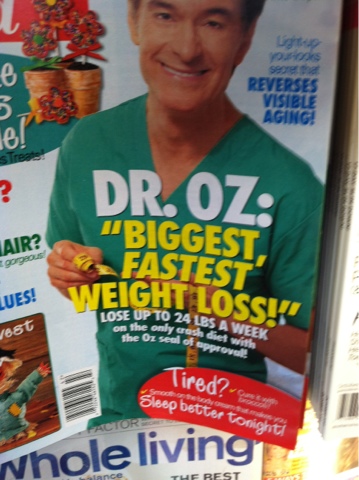
Lose 24 Pounds In a Week!

Yes. And it's approved by Dr. Oz. Lose 24 pounds in a week with the only crash diet approved by Dr. Oz!

I'm amazed at the headlines so I did my research. Instead if just belittling Dr. Oz and his reputation over such a stupid headline. We all know by now that crash diets don't work. Sure they work in the short term but longer term, if you don't make it a lifestyle change we know that you'll gain the weight back. Secondly, losing 24 pounds in one week just doesn't seem smart unless you drain fluid, cut off a limb or suction fat. But I am going down the wrong path. I want to bring you the facts so that YOU can make your own decision.

It's not Dr. Oz but Dr. Joel Fuhrman, weight loss expert, who came up with this "diet", but it is promoted on the Dr. Oz show and website, and as the headline reads "approved by Dr. Oz". Here are the principles of the "diet":

1. Eat as much as you want. However the foods of choice are nutrient dense low calorie foods. Bottom line is you are on a calorie restricted diet because you are consuming less calories.  But think about it.  You (we) probably do consume too many calories, because we consume too much of the wrong kinds of foods.  Change the kinds of foods we eat to more nutrient dense foods and you reduce the calories as well.

2. You will not be hungry because the nutrients stave off hunger. There is probably some science that substantiates certain nutrients, via the complex chemical reactions in our body, send a signal to the brain that we are not hungry.  But, for the most part, it won't help you through those "emotional cravings" or the "social binging".  You'll still have to work "emotionally" through those.

3. Beans are this diets superfood. Because 50% of beans are insoluble fiber (resistant starch), are not consumed/digested, and are passed through the body, you can eat a lot.  Plus, fiber helps make you feel full. 

4.  Eat vegetables!  Lots of them!  That's right and not coincidentally, most vegetables are non-fat, high fiber (makes you feel full) and are indeed nutrient dense and low calorie!  Go for it!  In fact, this diet supports a 90/10 philosophy.  90% of the foods you eat should be "vegetable-like" along with some high complex grains and limited nuts (for healthy omega-3).  10% of your foods can come from meat and dairy.  Hold on now...this is sounding more like a low-fat diet and that's not anything new!

5. BOM stands for berries, onions and mushrooms (more low calorie, high fiber vegetables/fruits).  These BOM foods are supposed to be anti-angiogenic and can starve your fat cells because they cut off the blood supply to them.  Research has been done to support these anti-angiogenic foods as cancer fighting because they cut off the blood supply to cancerous cells, stopping growth.  Makes sense to me, but as for your fat cells, you are born with a certain number and your goal is to shrink them.  You can do that by changing what you eat (not dieting) and by exercise.  Certain foods might help slightly.

6.  Fruit smoothies can help you quench hunger.  No coincidence that the major ingredient in their fruit smoothie is ice (water) and fresh berries (fiber and anti-angiogenic) and that's good for you.  

7.  NO PROCESSED FOODS!  I'll say that again, NO PROCESSED FOODS.  (duh!)

The tag line for the program states:
By feasting on nutrient-dense foods, you can lose weight faster and more efficiently. The goal of this crash diet is to dive right in, making the habits you learn and the recipes you make in the next 7 days part of a healthy and sustainable lifestyle.
Which brings me to my last point.  There is simply no way you can create habits over the course of one week.   Sure, you will learn the new habits of eating healthy, but it takes approximately 21 days to erase the old habits and establish the new ones, and it takes as much as 2-6 months to SET the new habits.  So, while this crash diet will steer you in the right direction, it is entirely up to you to stick with it and then, we are talking about lifestyle change, which is exactly what I've been preaching for the last few years.

What can you expect as far as weight loss goes?  I don't think it's realistic to lose 24 pounds in one week as that much weight loss is tied into your current weight and physiology.  If a 150 pound woman lost 24 pounds, that's almost 20% of her body weight in one week and that could send the body into a state of shock.  However, if a much larger person, say 240 pounds - well, that's still a 10% weight loss in a week, and that still doesn't sound safe.  What will happen is you will lose a lot of fluids because you are eliminating processed foods and are eating low fat.  Your fat cells may begin to shrink and you will feel less bloated.  You will probably lose 2-5 pounds.

But here's the next red flag:  if you don't make it a lifestyle change and you go back to your old habits and gain the weight right back, (as perhaps you have done a few times before), you will be yo-yo dieting, that familiar up, down, up, down of the scale.  Studies have indeed shown that yo-yo dieting is much worse for you in the long run than holding onto a few extra pounds.  (I'll address yo-yo dieting in another blog).  

So, either change your lifestyle once and for all, or don't start this diet at all.

But, please make your own decision.  Let me know your thoughts.

Kathy